
Preparing for exams can be stressful, especially when you have a large syllabus, limited time, difficult topics, and lots of notes to review. Students often spend hours trying to organize their study material, create revision schedules, practice questions, and understand complicated concepts.
Artificial intelligence can make many of these tasks easier.
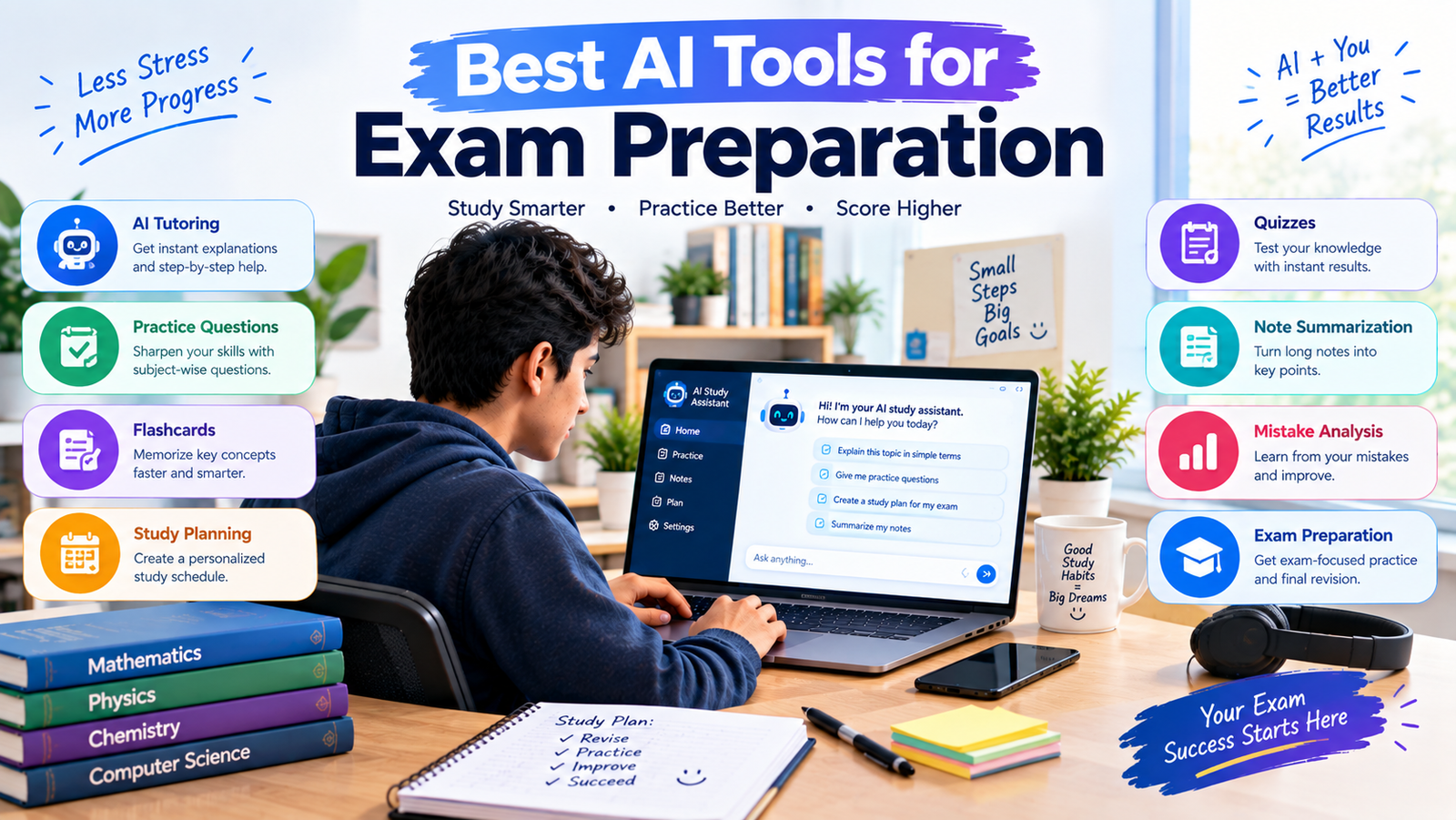
Today, AI study tools can help students create personalized study plans, summarize notes, generate practice questions, explain difficult concepts, create flashcards, improve revision, and identify areas that need more attention.
However, AI should be used as a study assistant rather than a replacement for studying. You still need to read your textbooks, understand concepts, practice problems, and verify important information.
In this guide, we will explore some of the best AI tools for exam preparation and explain how students can use them effectively.
Why Use AI for Exam Preparation?
Traditional exam preparation often involves reading textbooks, making notes, memorizing information, and solving practice questions.
AI can add another layer of support to this process.
For example, an AI tool can turn a difficult chapter into a simple explanation or convert your notes into practice questions.
Students can use AI to:
- Create personalized study schedules
- Summarize long study material
- Explain difficult concepts
- Generate practice questions
- Create flashcards
- Practice quizzes
- Identify weak areas
- Review mistakes
- Organize notes
- Brainstorm revision strategies
- Improve writing and grammar
- Prepare for presentations and oral exams
The biggest advantage is that AI can make studying more interactive instead of relying only on passive reading.
1. ChatGPT
ChatGPT can be useful for many different parts of exam preparation.
Students can use it to understand difficult concepts, create practice questions, generate quizzes, summarize their own notes, and build study schedules.
For example, instead of asking:
“Explain biology.”
You can give it a specific topic:
“Explain photosynthesis in simple language, then give me five questions to test my understanding.”
You can also use ChatGPT as a practice tutor.
For example:
“Act as my mathematics tutor. Give me one problem at a time. Do not show the answer until I attempt the problem.”
This type of interaction can make revision more active.
Best Uses
- Concept explanations
- Practice questions
- Study plans
- Revision summaries
- Quizzes
- Brainstorming
- Exam revision
2. Google Gemini
Google Gemini can also help students with studying, brainstorming, explanations, and document-based learning tasks.
You can ask it to explain complicated topics in different ways depending on your current level of understanding.
For example:
“Explain this topic as if I am a beginner. Then explain it at an intermediate level.”
You can also ask for questions based on a specific subject.
For example:
“Create 20 multiple-choice questions about the following topic. Put the answers at the end.”
This can be useful when you want to test yourself after completing a chapter.
Best Uses
- Concept explanations
- Brainstorming
- Revision
- Practice questions
- Study assistance
3. Microsoft Copilot
Microsoft Copilot can be useful for students who already work with Microsoft applications.
Students can use AI assistance to help organize information, improve written material, summarize content, and prepare documents.
For example, if you have a large set of study notes, you can use AI-assisted tools to help identify important concepts and organize them into a revision structure.
You can then turn that information into:
- Key points
- Revision notes
- Questions
- Study outlines
- Topic summaries
Best Uses
- Note organization
- Writing support
- Summarization
- Study organization
- Document-based work
4. Quizlet
Quizlet is well known for flashcards and study activities, and its AI-powered features can make revision more interactive.
Students can use study material to create flashcards and practice questions.
Flashcards are particularly useful for subjects that require remembering:
- Definitions
- Formulas
- Vocabulary
- Dates
- Terminology
- Concepts
- Important facts
Instead of reading the same notes repeatedly, students can use active recall by attempting to answer questions before looking at the answer.
Best Uses
- Flashcards
- Memorization
- Vocabulary
- Active recall
- Quick revision
5. Grammarly
Grammarly is primarily a writing assistant, but it can also be useful during exam preparation when students need to improve written answers.
This can be particularly helpful for subjects involving essays, reports, explanations, or written assignments.
You can use it to identify:
- Grammar mistakes
- Spelling errors
- Awkward sentences
- Clarity issues
- Writing problems
For example, after writing a practice essay, you can use a writing assistant to identify areas that could be clearer.
Remember that improving grammar is different from having AI write your answers for you.
Best Uses
- Essay practice
- Grammar
- Writing clarity
- Proofreading
- Academic writing
6. Perplexity
Perplexity can be useful when you want to research a topic and explore information from different sources.
Students can use research-focused AI tools to ask questions about unfamiliar subjects and investigate possible sources.
For example:
“Explain the causes of the Industrial Revolution and identify reliable sources I can use to study the topic.”
The important step is to check the original sources instead of accepting every AI-generated statement as fact.
Best Uses
- Research
- Topic exploration
- Understanding background information
- Finding sources
- Reviewing unfamiliar topics
7. NotebookLM
NotebookLM can be especially useful when you want to study from your own materials.
Instead of asking an AI about a general topic, you can work with the documents and notes you provide.
This can be helpful when preparing for an exam based on:
- Lecture notes
- Study guides
- Course documents
- Text materials
- Class resources
You can ask questions about your material and use AI assistance to organize or understand the information.
Best Uses
- Studying personal notes
- Document-based revision
- Summaries
- Questions about study material
- Reviewing course resources
8. Notion AI
Notion AI can help students organize their study information and manage revision tasks.
If you keep your notes and study schedule in Notion, AI features can help with organizing and working with that information.
For example, you might create separate sections for:
- Subjects
- Chapters
- Exam dates
- Revision tasks
- Weak topics
- Practice tests
A structured workspace can make exam preparation easier to manage.
Best Uses
- Study organization
- Notes
- Revision planning
- Task management
- Study schedules
9. Elicit
Elicit is designed around research and can be useful for students preparing for subjects that involve academic literature.
It can help students explore research papers and understand information from academic sources.
This can be especially useful for university students who need to prepare for exams involving research-heavy subjects.
Best Uses
- Academic research
- Research papers
- Literature review
- Understanding studies
- Academic information
10. Wolfram Alpha
For students studying mathematics, physics, statistics, and other quantitative subjects, computational tools can be useful for checking calculations and exploring mathematical concepts.
Wolfram Alpha can help with mathematical and computational queries.
However, students should not simply copy the final result.
A better approach is to understand how the answer was produced.
For example, after solving a problem yourself, you can use a computational tool to check your work and investigate where your calculation may have gone wrong.
Best Uses
- Mathematics
- Calculations
- Statistics
- Physics
- Formula checking
- Problem solving
How to Choose the Right AI Tool for Your Exam
You do not need to use every AI tool available.
The best choice depends on your subject and your study method.
For Understanding Difficult Topics
Use an AI chatbot to ask for simple explanations, examples, analogies, and follow-up questions.
For Memorization
Flashcard and quiz tools can be useful.
For Mathematics
Use computational and problem-solving tools to practice and check your work.
For Research-Based Subjects
Research-focused AI tools can help you explore academic information and sources.
For Writing Exams
Writing assistants can help you practice essays and improve grammar and clarity.
For Study Planning
AI chatbots and organization tools can help you create realistic revision schedules.
How to Use AI to Create a Study Plan
One of the easiest ways to use AI is to create a personalized study schedule.
For example, you can tell an AI tool:
“I have 14 days before my biology exam. I need to study eight chapters. I can study three hours per day. Create a realistic revision schedule with practice tests and review days.”
AI can then suggest a structure.
You should review the schedule and adjust it according to your actual energy levels, classes, deadlines, and priorities.
A good study plan should include:
- New material
- Revision
- Practice questions
- Breaks
- Mock tests
- Mistake review
- Final revision
Do not create a schedule that looks impressive but is impossible to follow.
How to Use AI for Practice Questions
Practice questions are one of the most useful ways to make AI part of your exam preparation.
For example:
“Create 15 multiple-choice questions about this chapter. Do not show the answers until I finish.”
After completing the questions, you can ask:
“Now show the answers and explain why each correct answer is correct.”
You can also request different difficulty levels:
“Create 10 beginner, 10 intermediate, and 10 advanced questions about this topic.”
This allows you to gradually increase the difficulty of your revision.
How to Use AI for Active Recall
Simply reading notes repeatedly does not always mean you understand the material.
Active recall requires you to retrieve information from memory.
AI can help by acting as a quiz partner.
Try:
“Ask me five questions about this chapter one at a time. Wait for my answer before giving feedback.”
This creates an interactive revision session.
You can also ask:
“Do not give me hints unless I specifically ask for one.”
This makes the exercise more challenging and can help you identify what you actually remember.
How to Use AI for Flashcards
Flashcards can be created from your notes using AI.
For example:
“Turn these notes into 30 question-and-answer flashcards. Focus on important concepts and definitions.”
You can then review the flashcards using active recall.
For subjects with many terms, flashcards can be particularly useful for quick revision sessions.
How to Use AI to Find Your Weak Areas
AI can also help you analyze your mistakes.
Suppose you complete 20 practice questions and get eight wrong.
Instead of simply checking the answers, you can ask:
“Analyze these mistakes and identify the topics I need to revise.”
You can then create a targeted revision list.
For example:
Weak Areas
- Chapter 3: Cell division
- Chapter 5: Genetics
- Chapter 7: DNA replication
You can then focus your study time on those areas instead of spending equal time on everything.
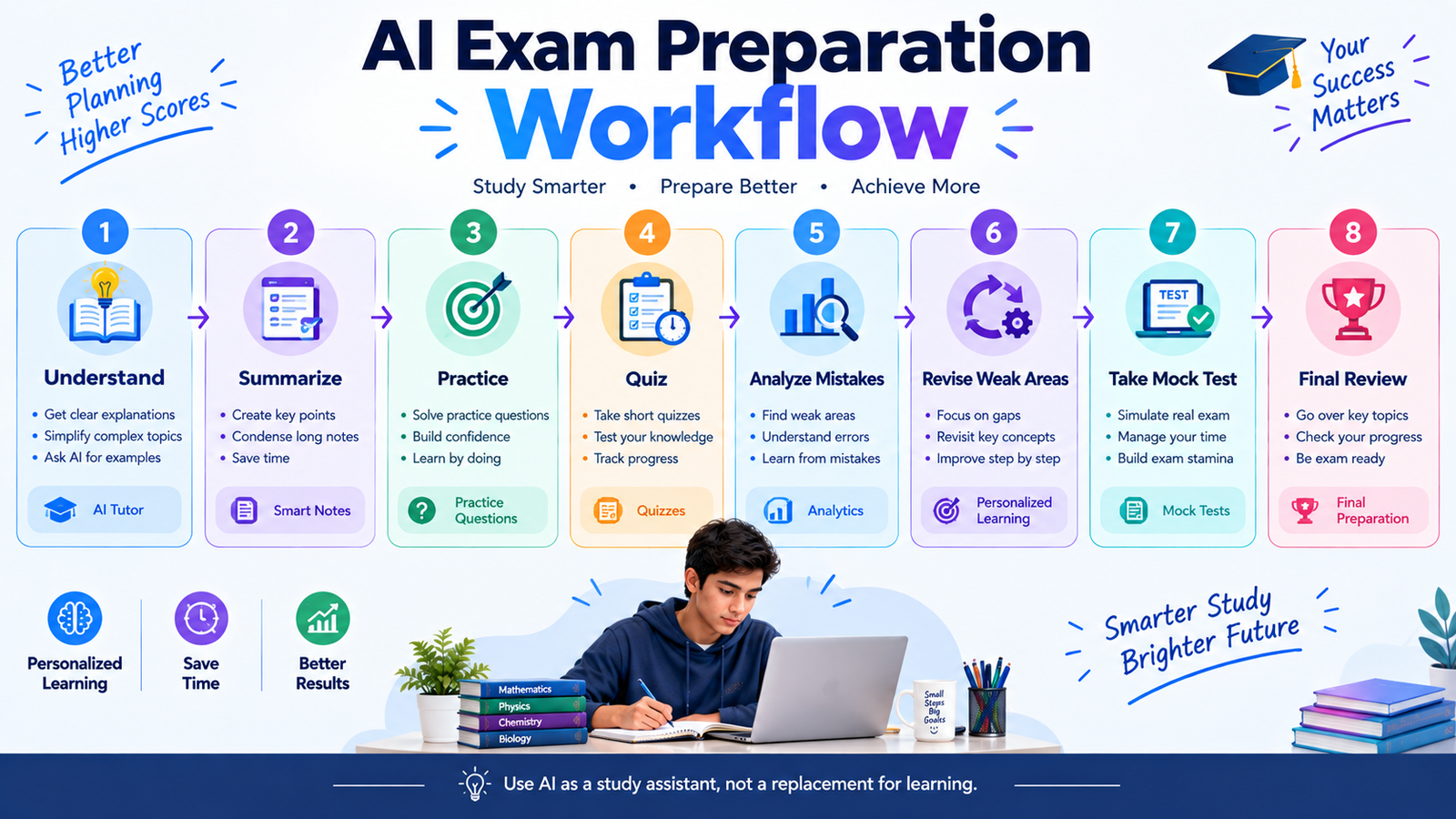
AI Exam Preparation Workflow
A simple AI-supported study workflow can look like this:
Understand → Summarize → Practice → Quiz → Analyze Mistakes → Revise Weak Areas → Take Mock Test → Final Review
The goal is to move from passive learning toward active practice.
AI can assist at almost every stage, but the student should still do the actual thinking and problem solving.
Useful AI Prompts for Exam Preparation
Here are some practical prompts students can use.
Study Plan Prompt
“Create a 10-day exam preparation plan for [subject]. I need to cover [topics] and can study [hours] per day.”
Summary Prompt
“Summarize these notes into concise exam revision points. Keep all important concepts.”
Quiz Prompt
“Create 20 practice questions from these notes without showing the answers.”
Flashcard Prompt
“Turn these notes into 25 flashcards using question-and-answer format.”
Difficult Topic Prompt
“Explain this topic in simple language, then give me two real-world examples.”
Active Recall Prompt
“Quiz me on this topic one question at a time. Do not show the answer until I respond.”
Mistake Analysis Prompt
“Analyze my incorrect answers and identify the concepts I should revise.”
Mock Exam Prompt
“Create a 60-minute mock exam based on these topics. Include a mix of easy, medium, and difficult questions.”
Final Revision Prompt
“Create a one-page final revision checklist for this subject.”
How to Use AI Responsibly for Exams
AI can be extremely useful, but students should avoid becoming dependent on it.
Here are some important rules.
Don’t Let AI Do All the Work
If AI explains every problem and gives you every answer, you may not develop the ability to solve problems independently.
Try the question yourself first.
Then use AI to check your reasoning or explain where you made a mistake.
Verify Important Information
AI can sometimes provide incorrect or incomplete information.
If something seems unusual or conflicts with your textbook or teacher’s material, investigate it further.
For exam preparation, your official course materials should remain an important reference.
Follow Your School’s AI Policy
Different schools, colleges, and universities may have different rules regarding AI.
Some instructors may allow AI for brainstorming or studying but restrict its use for assignments and assessments.
Always follow the rules provided by your institution or instructor.
Protect Your Personal Information
Avoid putting sensitive personal information, private academic records, passwords, or confidential documents into AI tools unless you understand how the service handles that information and you are permitted to do so.
Common Mistakes Students Make With AI Study Tools
Mistake 1: Using AI Instead of Studying
AI should support your study process, not replace it.
Mistake 2: Memorizing AI Answers
Understanding a concept is more valuable than memorizing a generated explanation.
Mistake 3: Never Practicing Without AI
You should regularly practice solving problems without assistance.
Mistake 4: Trusting Incorrect Information
Always verify important facts and formulas.
Mistake 5: Creating Unrealistic Study Plans
A 12-hour daily plan may look productive but can be difficult to maintain.
Mistake 6: Ignoring Your Mistakes
Getting a question wrong is useful if you understand why.
Use mistakes to guide your next revision session.
Benefits of AI Tools for Exam Preparation
When used properly, AI can provide several benefits.
Personalized Learning
Students can ask for explanations at different difficulty levels.
Faster Revision
AI can help turn large amounts of material into organized revision resources.
More Practice
Students can generate additional questions whenever they need them.
Immediate Feedback
AI can provide explanations and feedback during practice.
Better Organization
AI can help students manage topics, notes, schedules, and revision tasks.
Targeted Studying
Analyzing mistakes can help students identify areas that need more attention.
Limitations of AI Study Tools
AI is not perfect.
Some limitations include:
- Incorrect answers
- Incomplete explanations
- Outdated information
- Misinterpretation of questions
- Over-reliance on AI
- Lack of subject-specific context
- Possible academic-integrity concerns
AI tools should therefore be treated as assistants.
Your textbook, teacher, lecture material, official study guides, and your own practice remain important parts of exam preparation.
A Simple AI-Powered Exam Strategy
If you want a simple system, try this:
<strong>Step 1: Review your syllabus.</p>
<strong>Step 2: Divide the syllabus into smaller topics.
<p><strong>Step 3: Ask AI to create a realistic study schedule.
<strong>Step 4: Study each topic using your textbook and class materials.
<strong>Step 5: Ask AI to explain concepts you do not understand.
<strong>Step 6: Generate practice questions.
<strong>Step 7: Solve them without assistance.
<strong>8: Check your answers.
<strong>9: Analyze your mistakes.
<strong> 10: Revise weak areas.
<strong>11: Take a mock exam without AI.
<strong>Step 12: Use your results to plan final revision.
This approach keeps AI in a supporting role while you remain actively involved in learning.
Final Thoughts
The best AI tools for exam preparation are not necessarily the tools that give you the most answers. The most useful tools are those that help you understand concepts, practice actively, organize your study time, identify mistakes, and improve your revision process.
Tools such as ChatGPT, Gemini, Copilot, Quizlet, Grammarly, Perplexity, NotebookLM, Notion AI, Elicit, and Wolfram Alpha can support different parts of exam preparation.
The key is how you use them.
Instead of asking AI to study for you, use it as a tutor, quiz partner, research assistant, note organizer, and revision assistant. Combine AI with textbooks, class notes, practice problems, mock exams, and independent thinking.
Used this way, AI can become a practical part of a smarter and more organized exam preparation strategy.
