
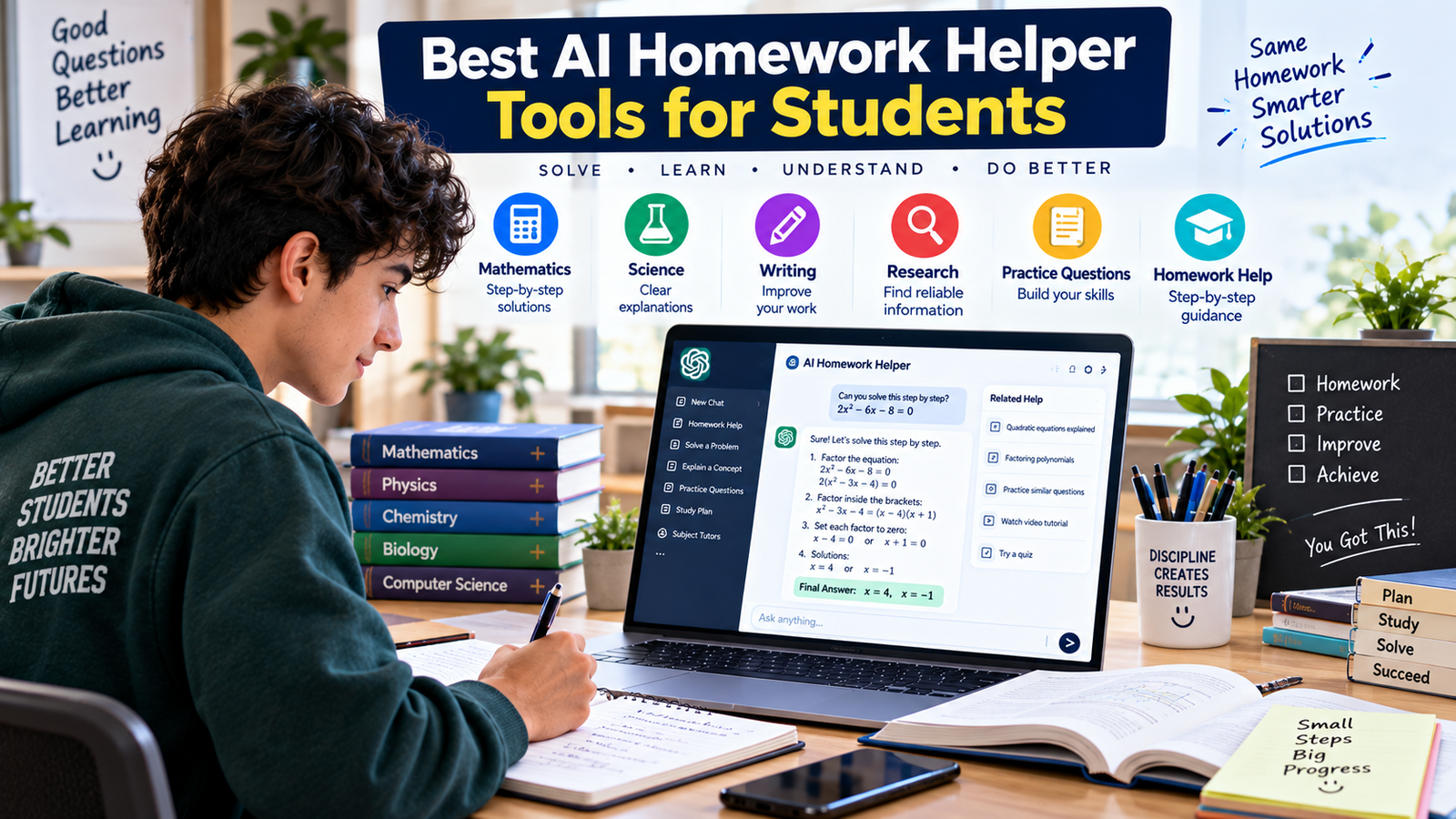
Homework can become difficult when students have multiple subjects, tight deadlines, and complicated questions to solve.
Artificial intelligence has made it easier to get help when you are stuck. Today, students can use AI homework helper tools to understand difficult concepts, solve problems step by step, review their work, create practice questions, and prepare for exams.
However, the best way to use AI for homework is not simply to copy an answer.
A good AI homework helper should help you understand how to reach the answer so that you can solve a similar problem yourself later.
In this guide, we’ll explore some of the best AI homework helper tools for students in 2026, what they can help with, and how to use them responsibly.
What Are AI Homework Helper Tools?
AI homework helper tools are applications that use artificial intelligence to provide assistance with academic tasks.
Depending on the tool, students can use AI to:
- Understand difficult concepts
- Solve math problems
- Explain science topics
- Review essays
- Summarize reading material
- Generate practice questions
- Create study guides
- Analyze homework questions
- Explain mistakes
- Prepare for exams
Some tools are general-purpose AI assistants, while others are designed specifically for mathematics, tutoring, research, or study practice.
The most useful approach is to treat AI as a learning assistant, not as a replacement for your own work.
Best AI Homework Helper Tools for Students
Here are some popular AI tools and tool categories students can consider for different homework needs.
1. ChatGPT
ChatGPT is a flexible AI assistant that can help with many different school and college subjects.
Students can use it to:
- Explain difficult concepts
- Solve problems step by step
- Review answers
- Create practice questions
- Summarize notes
- Create study plans
- Explain mistakes
- Practice languages
For homework, a useful prompt is:
“Don’t give me the final answer immediately. Guide me through this problem step by step and give me a hint when I get stuck.”
ChatGPT also offers Study Mode, which is designed around guided learning, questions, step-by-step explanations, and knowledge checks. It can help students work through difficult concepts instead of simply receiving an answer.
This makes it useful for students who want homework help while still doing the thinking themselves.
2. Google Gemini
Google Gemini can also provide homework support across different subjects.
Google’s student-focused features include tools for working with uploaded course materials, creating study guides, and getting step-by-step help with homework questions.
For example, students can ask:
“Walk me through this math problem and explain why each step works.”
You can also use Gemini to understand difficult concepts, review notes, and generate practice questions.
As with any AI tool, important answers should be checked against your course materials and reliable sources.
3. Khanmigo
Khanmigo is an AI-powered learning assistant connected with Khan Academy’s educational content.
Its approach focuses on guided learning rather than simply giving students answers.
This can be useful when you want help understanding:
- Mathematics
- Science
- Writing
- History
- Other academic topics
A tutoring-focused tool can be especially useful when your goal is to understand the method behind a homework problem.
Instead of asking:
“What is the answer?”
Try:
“Give me a hint that will help me solve this problem myself.”
4. Photomath
Photomath is designed primarily for mathematics.
Students can use it to scan or enter math problems and receive explanations of the solution process.
It can be useful for topics such as:
- Arithmetic
- Algebra
- Geometry
- Trigonometry
- Calculus
For example, if you are stuck on a handwritten equation, you can use a camera-based math tool to examine the problem.
The best way to use it is to study the steps rather than simply copy the final number.
5. Wolfram|Alpha
Wolfram|Alpha can be useful for computational and mathematical questions.
Students may use it for:
- Algebra
- Calculus
- Statistics
- Equations
- Scientific calculations
- Physics-related calculations
It can be particularly helpful when you want to check a calculation or explore a mathematical concept.
For learning, try solving the problem yourself first.
Then use the tool to check your work and investigate where your calculation differs.
6. Quizlet
Quizlet is useful when homework involves memorization and practice.
Students can use it for:
- Vocabulary
- Definitions
- Languages
- Science terms
- Historical information
- Exam review
Instead of only reading your homework material, you can turn important information into flashcards or practice questions.
For example:
“Create flashcards for the 20 most important terms from this chapter.”
This can turn homework review into active practice.
7. Notebook-Style AI Study Tools
AI notebook tools can be useful when homework is based on specific course materials.
For example, you may have:
- Lecture notes
- PDFs
- Textbook chapters
- Slides
- Research documents
You can use an AI notebook to ask questions about those materials and create summaries or study resources.
This can be especially useful when you want your homework help to stay connected to the material provided by your teacher.
8. Grammarly
Grammarly can help students with writing-related homework.
It can assist with areas such as:
- Grammar
- Spelling
- Sentence clarity
- Word choice
- Writing style
- Basic proofreading
For example, instead of asking AI to write your entire essay, you can write your own draft and use a writing assistant to identify areas that need improvement.
Try asking:
“Review this paragraph for grammar and clarity while keeping my original ideas.”
This can help you improve your writing without replacing your own work.
9. Perplexity
Perplexity can be useful for research-oriented homework.
Students can use research-focused AI tools to:
- Explore topics
- Find information
- Ask follow-up questions
- Discover potential sources
- Understand background information
For example:
“Explain the main causes of the Industrial Revolution and identify reliable sources I should explore.”
However, don’t rely on an AI summary alone.
Open the original sources and evaluate them before using information in an assignment.
10. AI Writing and Brainstorming Tools
Students sometimes need help getting started with a writing assignment.
AI can help with:
- Brainstorming
- Topic ideas
- Essay outlines
- Research questions
- Argument structures
- Draft feedback
For example:
“Give me five possible arguments for an essay about the effects of social media on education. Don’t write the essay.”
This gives you ideas while leaving the actual writing and reasoning to you.
How to Choose the Best AI Homework Helper
There is no single homework tool that is perfect for every student.
The right tool depends on the type of homework you are doing.
For general homework: Use a general AI tutor such as ChatGPT or Gemini.
>For mathematics: Consider math-focused tools such as Photomath or Wolfram|Alpha.
>For memorization: Flashcard and quiz tools such as Quizlet can be useful.
>For writing: Grammar and writing assistants can help review your work.
>For research: Use research-focused AI tools, but verify original sources.
For guided tutoring: Look for tools that use hints, questions, and step-by-step explanations.
The goal should be to choose a tool that helps you learn the method, not simply obtain an answer.
How to Use AI Homework Helpers Effectively
Using AI correctly can make a major difference.
Instead of asking:
“Give me the answer.”
Try:
“Help me solve this problem step by step. Don’t give me the final answer until I have tried it.”
You can also ask:
“Give me one hint at a time.”
Or:
“Explain why my answer is wrong and let me try again.”
These prompts encourage active learning.
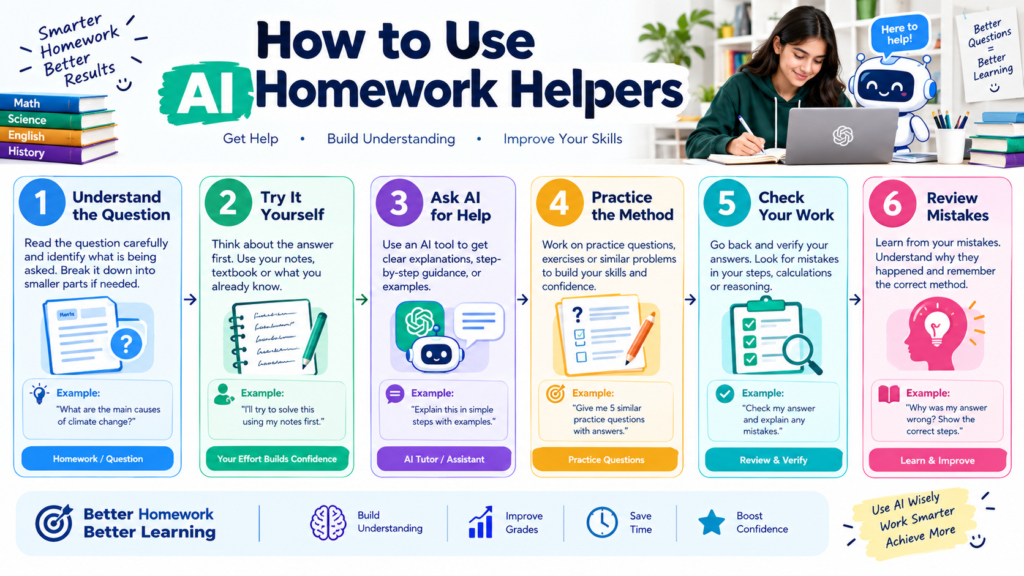
A simple homework workflow is:
Read → Try → Ask → Practice → Check → Review
First, read the question carefully.
Then try to solve it yourself.
If you get stuck, ask AI for a hint or explanation.
After receiving help, solve the problem again without looking at the response.
Finally, review your mistakes.
Use AI to Explain Difficult Homework Questions
Sometimes the biggest problem isn’t solving the homework—it’s understanding what the question is asking.
AI can help break a complicated question into smaller parts.
For example:
“Explain what this question is asking me to do. Don’t solve it yet.”
This can be particularly useful for word problems, science questions, and essay prompts.
Once you understand the question, try solving it yourself.
Use AI for Math Homework
Math is one of the most common areas where students use AI assistance.
You can ask AI to:
- Explain a formula
- Demonstrate a method
- Give a similar example
- Check your calculation
- Identify a mistake
- Create practice problems
For example:
“I don’t understand how to factor this equation. Explain the method using a simpler example first.”
This is usually more useful than asking:
“Solve this equation.”
Once you understand the method, try the original problem yourself.
Use AI for Science Homework
AI can also help explain science concepts.
For example:
“Explain Newton’s laws in simple language and give me a real-world example for each law.”
You can then ask:
“Now quiz me on the three laws.”
This creates a learning cycle instead of simply generating an answer.
For scientific homework, verify important facts with your textbook, teacher’s material, or reliable scientific sources.
Use AI for Essay Homework
AI can support the writing process without necessarily writing the entire assignment.
You can use it to:
- Understand the question
- Brainstorm ideas
- Build an outline
- Identify weak arguments
- Review grammar
- Improve clarity
- Suggest areas where evidence is needed
For example:
“Here is my essay outline. Identify three areas where my argument needs stronger evidence.”
This provides useful feedback while keeping the actual work yours.
.
Don’t Use AI to Simply Copy Answers
The easiest way to misuse an AI homework helper is to copy the response without understanding it.
This may help you finish an assignment, but it doesn’t necessarily help you prepare for the exam.
Instead, use AI to:
- Explain
- Guide
- Give hints
- Provide examples
- Check your work
- Create additional practice
Think of AI as a tutor sitting beside you rather than a person doing your homework for you.
Verify AI-Generated Answers
AI tools can make mistakes.
An answer may look confident and still be incorrect.
This is particularly important for:
- Mathematics
- Science
- History
- Statistics
- Research
- Technical subjects
Always compare important information with your textbook, teacher’s notes, academic sources, or other reliable references.
For example, if AI gives you a historical date, formula, or scientific claim, verify it before including it in important academic work.
Don’t Ignore Your School’s AI Rules
Different schools, universities, and teachers may have different rules regarding AI.
Some assignments may allow AI for brainstorming or research.
Others may restrict or prohibit AI-generated content.
lass=”yoast-text-mark” />>Before using an AI homework helper for graded work, check the applicable rules.
>Using AI responsibly means understanding what your teacher allows and following those requirements.
Protect Your Personal Information
Students should also be careful about what they upload to AI tools.
Avoid unnecessarily sharing:
-
-
- Passwords
- Personal identification information
- Private academic records
- Confidential documents
<l
-
i>
Other people’s private information
If you upload homework, notes, or documents, review the information first and make sure you’re allowed to share it.
Best AI Homework Helper by Study Need
| Homework Need | Useful Tool Type |
|---|---|
| General homework | AI tutor |
| Mathematics | Math solver |
| Science | AI tutor and research tools |
| Writing | Writing and grammar tools |
| Research | Research-focused AI |
| Memorization | Flashcard tools |
| Exam practice | Quiz and practice tools |
| Difficult concepts | Guided AI tutor |
| Calculations | Computational tools |
| Study materials | AI notebook tools |
A Simple AI Homework Routine
You can use this routine for almost any subject.
Step 1: Read the Question
Make sure you understand what the assignment is asking.
Step 2: Try It Yourself
Spend a few minutes attempting the problem before using AI.
Step 3: Ask for Help</h3>
If you’re stuck, ask AI for a hint or explanation.
Step 4: Solve It Again
Close the AI response and attempt the problem yourself.
Step 5: Check Your Answer
Use AI to identify mistakes.
Step 6: Practice a Similar Problem
Ask AI to create another question that uses the same concept.
Step 7: Test Yourself
Solve the new problem without assistance.
This routine helps turn AI homework help into actual learning.
Common Mistakes Students Make With AI Homework Helpers
Asking for the Final Answer First
<p>Try to solve the problem before asking for the answer.
Copying Everything
Don’t submit AI-generated wo
rk as your own when your school’s rules don’t permit it.
Not Checking the Answer
<p>AI can make mistakes, so verify important information.
Using the Same Tool for Everything
Different tools are useful for different subjects.
Ignoring Your Teacher’s Instructions
Your course materials and teacher’s requirements should remain your main guide.
Becoming Dependent on AI
Make sure you can solve similar problems without AI.
Final Thoughts
The best AI homework helper tools can make difficult assignments easier to understand and provide useful support when you get stuck.
Tools such as ChatGPT, Gemini, Khanmigo, Photomath, Wolfram|Alpha, Quizlet, Grammarly, and research-focused AI tools can support different types of homework.
But the most important thing is how you use them.
Instead of asking AI to complete your homework, ask it to explain the concept, provide hints, check your reasoning, and create additional practice.
The goal should be simple:
Use AI to learn the answer—not just to get the answer.
When used responsibly, AI homework helpers can become useful study partners while keeping your own thinking, practice, and understanding at the center.
