
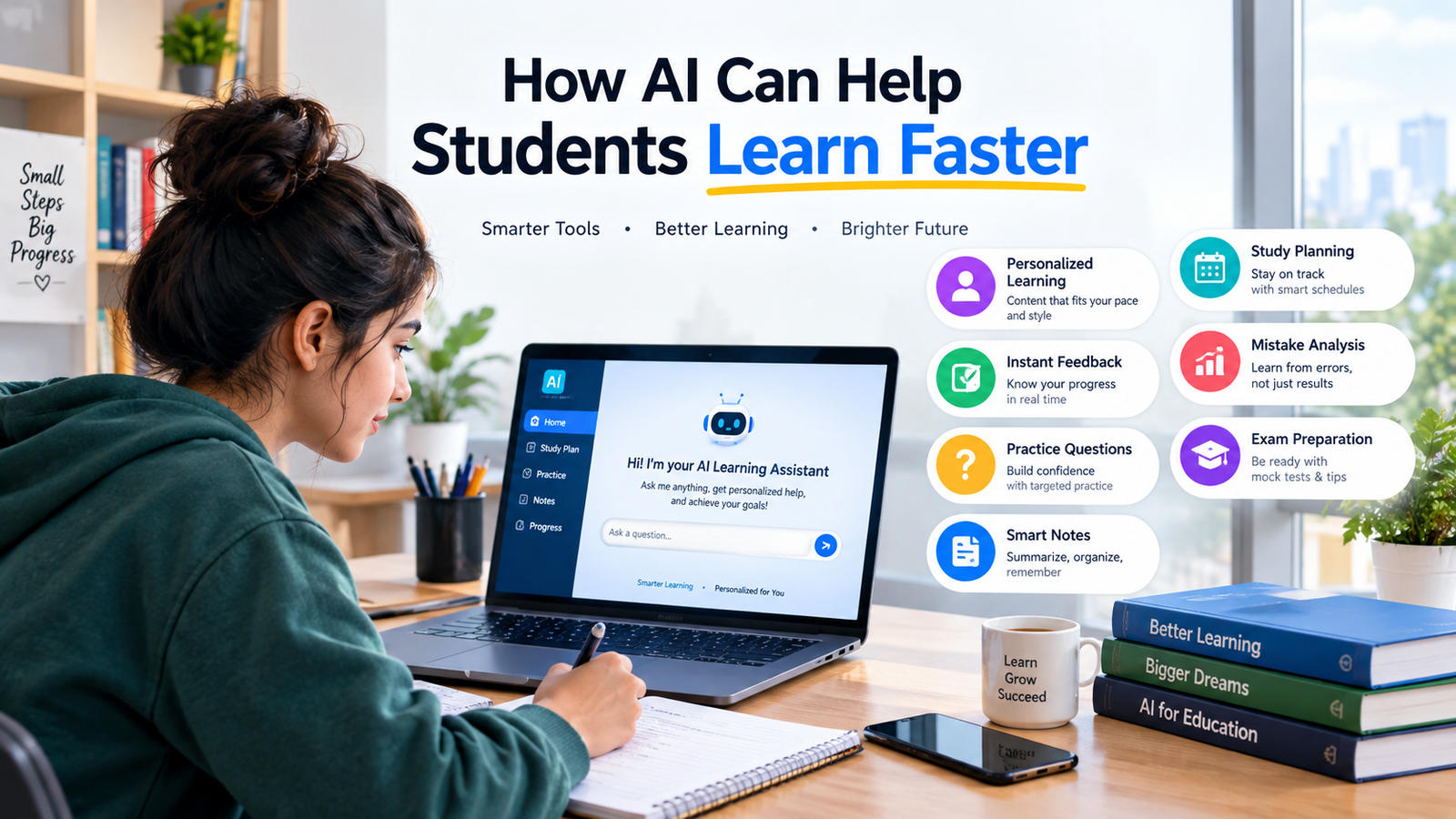
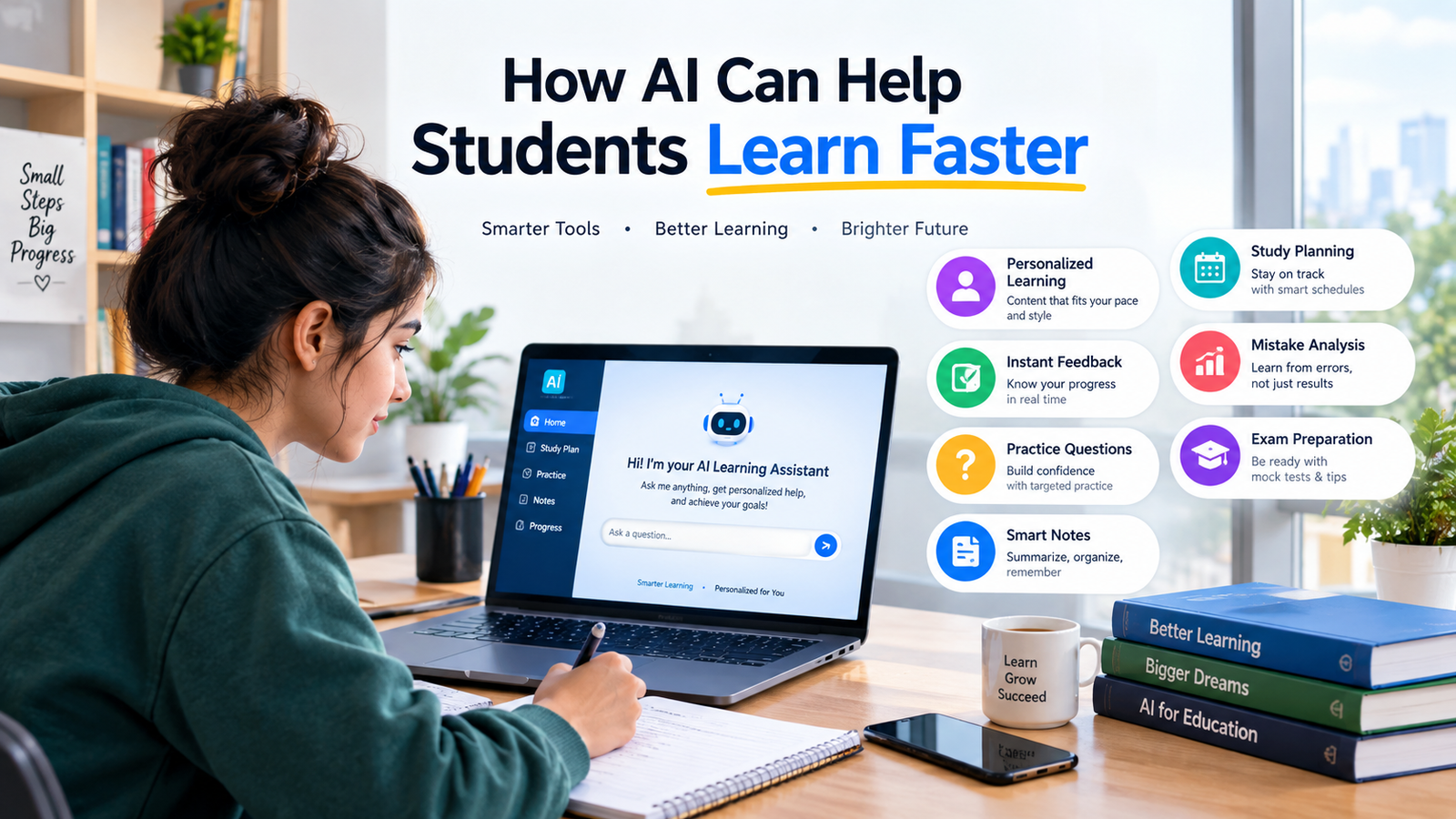
Artificial intelligence is becoming an increasingly useful part of modern education. Students can now use AI tools to understand difficult subjects, organize their study material, create practice questions, receive feedback, and prepare for exams.
In the past, students often had to search through textbooks, websites, videos, and notes whenever they were stuck on a difficult topic. AI can make this process more interactive by providing explanations and learning support based on the student’s questions.
However, learning faster does not mean allowing AI to do all the work. The real advantage comes from using AI as a personal learning assistant while continuing to think, practice, and solve problems independently.
In this guide, we will explore practical ways AI can help students learn faster and how students can use it effectively without becoming dependent on it.
What Does Learning Faster Really Mean?
Learning faster is not simply about finishing homework quickly.
Good learning means understanding a concept, remembering important information, practicing what you learned, and being able to use that knowledge independently.
AI can help reduce the time students spend on repetitive study tasks while giving them more opportunities to focus on understanding and practice.
For example, instead of spending a long time trying to understand one complicated paragraph, a student can ask an AI assistant to explain the same concept using simpler language and examples.
The student can then return to the original material with a better understanding.
This makes AI most useful when it supports the learning process rather than replacing it.
1. AI Can Explain Difficult Topics in Simple Language
One of the easiest ways students can use AI is by asking it to explain complicated subjects in simpler terms.
Textbooks sometimes use advanced terminology that beginners find difficult to understand. AI can provide alternative explanations based on the student’s level.
For example, a student studying biology could ask:
“Explain photosynthesis in simple language and give me three real-life examples.”
A mathematics student could ask:
“Explain quadratic equations step by step as if I am learning them for the first time.”
Students can also ask AI to explain a topic using:
- Simple language
- Real-world examples
- Analogies
- Step-by-step explanations
- Short summaries
- Question-and-answer formats
This can make difficult concepts easier to understand.
2. AI Provides Personalized Learning Support
Every student learns differently.
Some students need detailed explanations, while others prefer short summaries. Some understand a concept immediately, while others need several examples before it becomes clear.
AI allows students to customize the way information is presented.
A student could say:
“Explain this topic at a beginner level.”
Then, after understanding the basics:
“Now explain the same topic at an advanced level.”
Students can also ask AI to focus specifically on the areas they find difficult.
This creates a more personalized learning experience than simply reading the same explanation repeatedly.
3. AI Gives Instant Feedback
Feedback is an important part of learning.
When students complete an exercise, they need to know whether their reasoning is correct. Waiting for feedback can sometimes slow down the learning process.
AI can provide immediate feedback for many types of study activities.
For example, students can ask:
“Check my answer and explain where my reasoning went wrong.”
Instead of only receiving a corrected answer, students can ask AI to identify the specific mistake.
This helps students understand:
- What they did wrong
- Why the mistake happened
- What the correct method is
- How to avoid the same mistake
The student should still verify important information because AI can sometimes make errors.
4. AI Can Create Practice Questions
Practice is one of the most important parts of learning.
Students can use AI to generate additional questions whenever they need more practice.
For example:
“Create 10 practice questions about fractions. Start with easy questions and gradually make them harder.”
AI can generate different types of exercises, including:
- Multiple-choice questions
- Short-answer questions
- True-or-false questions
- Problem-solving exercises
- Flashcards
- Mock tests
- Revision quizzes
Students can first attempt the questions without assistance.
Afterward, they can ask AI to explain the questions they got wrong.
This creates a useful learning cycle:
Learn → Practice → Check → Correct → Practice Again
5. AI Helps Students Make Better Study Notes
Good notes can make revision much easier.
Students can use AI to organize complicated information into a clearer structure.
For example, students can provide their own notes and ask:
“Turn these notes into a one-page revision summary.”
They can also request:
- Important definitions
- Key concepts
- Important formulas
- Main arguments
- Examples
- Questions and answers
- Revision checklists
This can save time when preparing for an exam.
However, students should compare AI-generated summaries with their original notes or textbook. A summary may leave out information that is important for a particular course or examination.
6. AI Can Help Create a Study Schedule
Many students struggle not because they lack study material, but because they do not know how to organize their time.
AI can help create a study plan based on subjects, available study time, deadlines, and exam dates.
For example:
“I have five chapters to study in seven days. I can study two hours every evening. Create a realistic study schedule.”
AI can divide the work into smaller daily tasks.
A study plan could look like:
Monday: Chapter 1
Tuesday: Chapter 2 + practice questions
Wednesday: Chapter 3
Thursday: Chapter 4 + revision
Friday: Chapter 5
Saturday: Mock test
Sunday: Review mistakes and weak topics
Breaking a large goal into smaller tasks can make studying feel more manageable.
7. AI Can Help Students Learn From Mistake
Mistakes are valuable learning opportunities.
Instead of simply correcting an incorrect answer, students can ask AI to explain why they made the mistake.
For example:
“Here is my solution. Explain exactly where I made the mistake and show me how to approach this problem correctly.”
Students can then create a mistake log.
A simple mistake log can include:
- Question
- My answer
- Correct answer
- What went wrong
- Correct method
- Similar practice question
Reviewing this information before an exam can help students focus on areas where they need more practice.
8. AI Can Make Exam Preparation More Efficient
Preparing for exams often requires reviewing large amounts of information.
AI can help students organize their revision and practice.
Students can ask AI to create a mock exam based on specific topics.
For example:
“Create a 25-question practice test covering these five topics. Do not provide the answers until I finish.”
After completing the test, students can ask:
“Analyze my mistakes and tell me which topics I should revise.”
AI can also help create flashcards, revision questions, summaries, and study checklists.
The important thing is to use these tools as preparation aids rather than relying on them as the only source of information.
9. AI Can Help Students Study Actively
Passive studying means simply reading information again and again.
Active learning requires students to think, answer questions, explain concepts, and solve problems.
AI can support active learning by acting like a tutor.
For example, students can say:
“Teach me this topic by asking me one question at a time. Wait for my answer before continuing.”
This turns studying into an interactive conversation.
Students can also ask AI to challenge them:
“Ask me five questions about this chapter. Increase the difficulty when I answer correctly.”
This type of interaction can encourage students to actively recall information instead of simply reading it.
10. AI Can Help Students Save Time
Students often spend a lot of time on tasks surrounding their actual studying.
They may need to organize notes, create practice questions, summarize material, or plan revision.
AI can assist with some of these tasks.
For example, instead of manually creating 20 practice questions, a student can ask an AI tool to generate them.
Instead of reorganizing a long set of notes, students can ask AI to structure their own material into headings and bullet points.
The time saved can then be used for more important activities such as:
- Solving problems
- Reading
- Practicing
- Reviewing mistakes
- Testing knowledge
Saving time is useful only when the extra time is used for meaningful learning.
A Simple AI Learning Workflow for Students
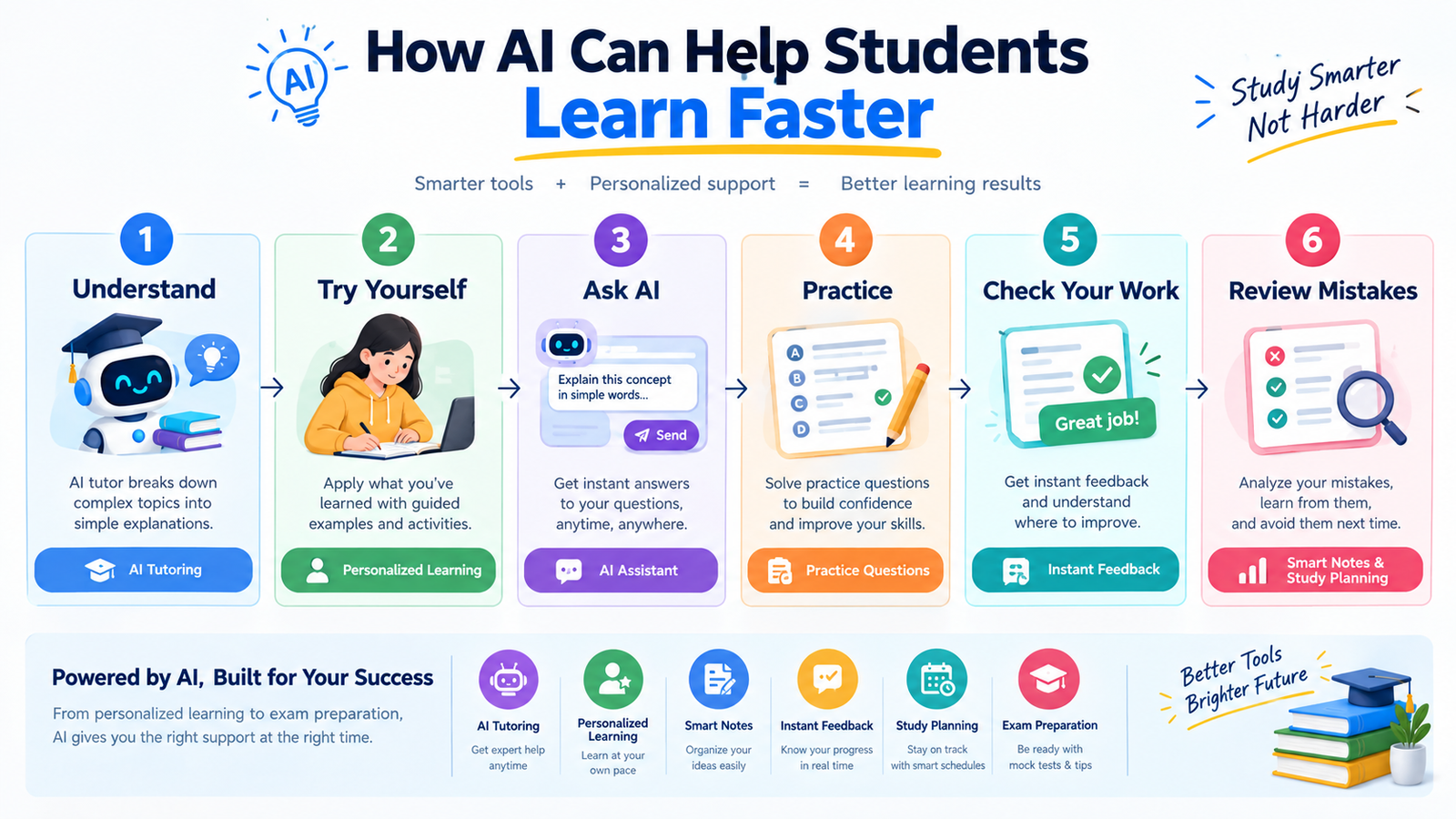
Students can follow a simple six-step process when using AI for studying.
Step 1: Understand the Question
Read the question carefully and identify exactly what is being asked.
Step 2: Try It Yourself
Use your own knowledge, textbook, or notes before asking AI.
Step 3: Ask AI for Help
If you are stuck, ask AI for a hint, explanation, example, or step-by-step guidance.
Step 4: Practice the Method
Solve similar questions without copying the AI’s response.
Step 5: Check Your Work
Compare your solution with the explanation and identify any mistakes.
Step 6: Review Mistakes
Write down what you learned and try another similar problem.
This approach keeps the student involved throughout the learning process.
Best AI Prompts Students Can Use
Students do not need complicated prompts to get useful learning support.
For Understanding
“Explain this topic in simple language and give me three examples.”</span>
>For Step-by-Step Learning
“Teach me this problem step by step without skipping any important steps.”
>For Practice
“Create 10 practice questions about this topic without showing the answers.”
>For Mistakes
“Check my answer and explain exactly where my reasoning went wrong.”
/>>For Revision
“Turn these notes into a concise revision guide.”
<h3>For Exam Preparation
“Create a seven-day study plan for my upcoming exam.”
For Active Lear
ning
“Quiz me on this topic one question at a time and explain my mistakes.”
These prompts encourage AI to support the student’s learning process rather than simply providing final answers.
Benefits of Using AI for Learning
When used responsibly, AI can provide several benefits for students.
Personalized Explanations
Students can request explanations at different levels and in different formats.
Faster Feedback
Students can receive immediate guidance while practicing.
More Practice
AI can generate additional questions whenever students need them.
Better Organization
AI can help structure notes, revision materials, and study plans.
More Efficient Revision
Students can use summaries, flashcards, and practice tests to organize their preparation.
Improved Understanding
Asking follow-up questions can help students explore difficult concepts more deeply.
What Are the Risks of Using AI for Studying?
AI is useful, but students should understand its limitations.
AI can sometimes provide incorrect information or misunderstand a question. For important academic topics, students should verify information using textbooks, teachers, course materials, or reliable academic sources.
Another problem is overdependence.
If students allow AI to solve every problem, write every assignment, and provide every answer, they may finish their work without developing the skills they actually need.
Students should also follow the academic integrity rules of their school, college, or university.
The goal should be:
Use AI to learn better, not to avoid learning.
How to Use AI Responsibly as a Student
A responsible AI learning strategy is simple.
Try the problem yourself first.
Ask AI for an explanation when you are stuck.
Use AI to generate practice questions.
Check important information.
Solve problems independently after learning the method.
Review your mistakes.
And always follow your institution’s rules about acceptable AI use.
Students should also avoid sharing unnecessary personal or sensitive information with AI tools.
Final Thoughts
AI can help students learn faster by providing personalized explanations, instant feedback, practice questions, smart notes, study schedules, mistake analysis, and exam preparation support.
However, the biggest benefit does not come from getting answers instantly. It comes from using AI to understand why an answer is correct and learning how to solve similar problems independently.
The most effective approach is to use AI as a learning assistant:
Try → Ask → Understand → Practice → Check → Improve.
When students combine AI with textbooks, teachers, critical thinking, active practice, and independent learning, AI can become a valuable tool for making education more organized and effective.
