
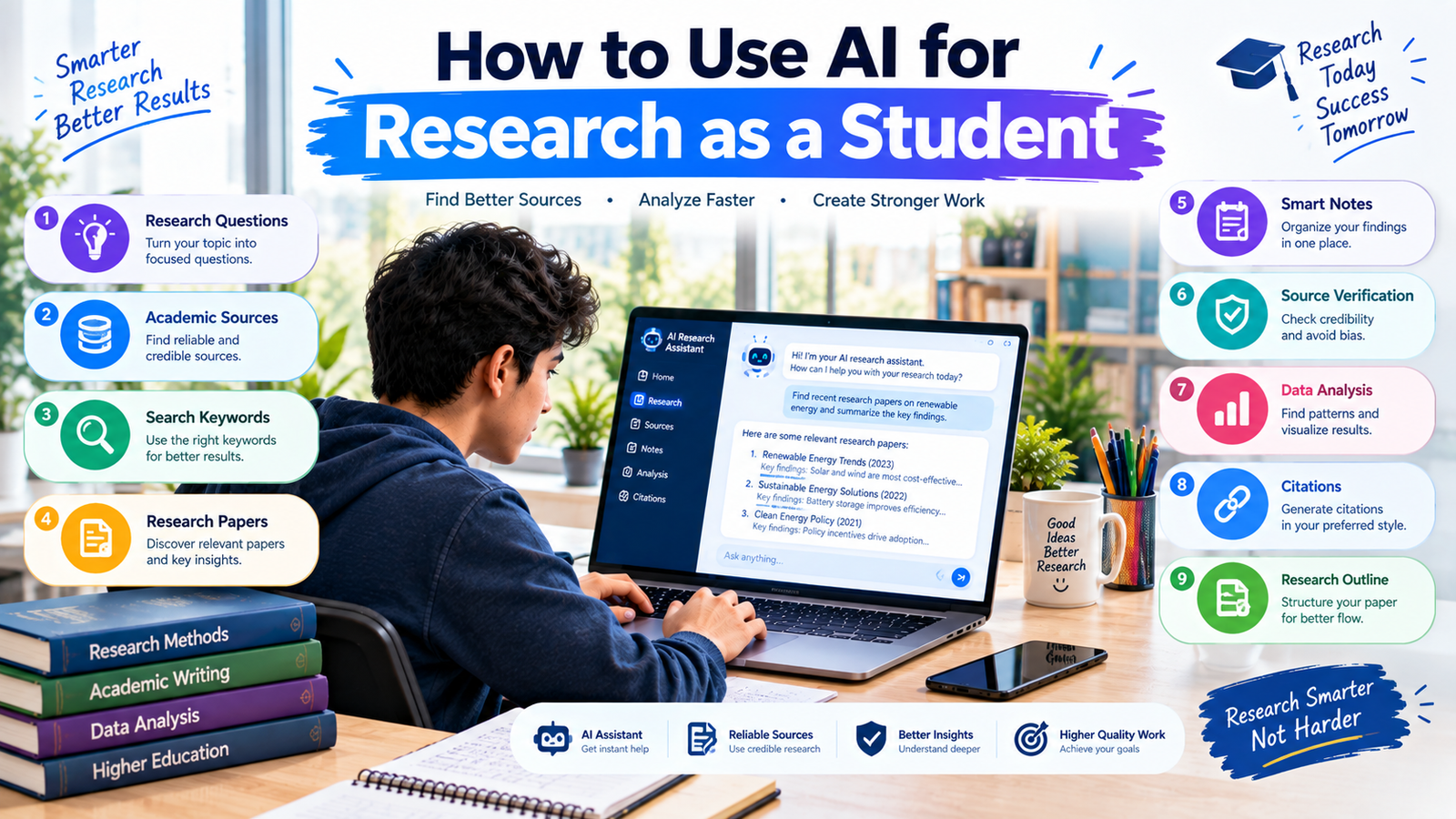
Research is an important part of school, college, and university education. Whether you are writing an essay, preparing a presentation, completing a research paper, or working on a final project, you often need to find reliable information, understand complex topics, organize notes, and support your ideas with evidence.
Artificial intelligence can make many of these research tasks easier. AI tools can help students brainstorm topics, discover useful keywords, summarize information, organize research notes, compare ideas, and improve the structure of an academic project.
However, AI should be used as a research assistant, not as a replacement for your own thinking. Students still need to read sources, verify information, evaluate evidence, and follow their school’s academic policies.
In this guide, you will learn how to use AI for research as a student in a practical and responsible way.
What Can AI Do for Student Research?
AI can support different stages of the research process.
For example, you can use AI to:
- Brainstorm research topics
- Narrow down a broad subject
- Create research questions
- Find useful search keywords
- Explain difficult concepts
- Summarize long texts
- Organize research notes
- Compare different ideas
- Create research outlines
- Identify possible gaps in your research
- Improve grammar and clarity
- Suggest questions for further investigation
The important thing is to use AI to speed up your research process while keeping yourself responsible for the final work.
1. Start by Choosing a Research Topic
The first step is deciding what you want to research.
Sometimes a teacher gives you a broad subject, such as climate change, artificial intelligence, social media, education, or renewable energy. The problem is that broad topics can be difficult to research effectively.
AI can help you narrow the topic.
For example, instead of asking:
“Tell me about climate change.”
You could ask:
“Give me 10 specific research topics about how climate change affects agriculture. Make them suitable for a college research paper.”
AI can provide different directions that you can evaluate and refine.
Remember that AI-generated ideas are starting points. You should choose a topic based on your assignment requirements and the availability of credible sources.
2. Create a Strong Research Question
A good research question gives your project direction.
Instead of researching everything about a subject, you can use AI to turn a broad topic into a focused question.
For example:
Broad topic: AI in education
More focused question: How does the use of AI-based learning tools affect student study habits?
You can ask AI:
“Help me turn this topic into five focused research questions suitable for a student research paper.”
Then compare the suggestions and choose a question that is specific enough to investigate.
A strong research question can save you considerable time because it helps determine what information you actually need.
3. Use AI to Generate Search Keywords
Finding the right keywords is an important research skill.
Suppose your research question is about the effects of social media on college students. You might search for:
- social media and college students
- social media effects on students
- social media academic performance
- social media student concentration
- social media and learning behavior
AI can help you create additional keyword combinations.
Try asking:
“Generate 20 academic search keywords and phrases for research about social media and college student academic performance.”
You can then use these keywords in academic databases, library catalogs, scholarly search engines, and other reliable research sources.
4. Use AI to Understand Difficult Concepts
Academic sources can sometimes contain complicated terminology.
Instead of ignoring a difficult section, you can ask AI to explain the concept in simpler language.
For example:
“Explain this concept in simple language and give me three examples.”
You can also provide a passage from your study material and ask:
“Explain the main idea of this passage using language suitable for a first-year college student.”
This can help you understand research before you use it in your own writing.
The goal should be understanding, not simply copying an AI-generated explanation.
5. Use AI to Summarize Research Papers
Students often need to read several papers or articles during research. AI can help you identify the main points more quickly.
Depending on the tool you use, you may be able to provide a document or text and ask for:
- Main argument
- Research question
- Methodology
- Key findings
- Important limitations
- Conclusion
- Important terms
For example:
“Summarize this research paper and separate the research question, methodology, key findings, limitations, and conclusion.”
This can make your initial review more efficient.
However, do not rely only on the AI summary. Read the original source, especially when you are using specific facts, statistics, arguments, or quotations.
6. Organize Your Research Notes With AI
Research can quickly become difficult to manage when you collect information from many sources.
AI can help you turn unorganized notes into a clearer structure.
For example, you can provide your notes and ask:
“Organize these research notes into themes. Keep the original meaning and identify which ideas belong together.”
You could organize notes into categories such as:
- Background
- Causes
- Effects
- Evidence
- Different viewpoints
- Case studies
- Limitations
- Possible solutions
This can make it easier to build your research paper later.
7. Compare Different Sources and Ideas
Research often involves understanding different perspectives.
AI can help you create a comparison framework.
For example:
“Create a comparison table showing the main arguments, evidence, limitations, and conclusions of these three sources.”
This can help you identify similarities and differences.
However, AI should not decide whether a source is credible simply because it sounds convincing. You should examine the original publication, author, date, methodology, citations, and other relevant information yourself.
8. Use AI to Find Gaps in Your Research
Once you have collected information, you can ask AI questions about what may be missing.
For example:
“Based on these research notes, what important questions have I not addressed?”
Or:
“What additional areas should I investigate before writing my research paper?”
This can help you discover areas that deserve further investigation.
AI suggestions are not proof that a research gap actually exists. Treat them as ideas for additional research rather than established academic conclusions.
9. Create a Research Paper Outline
Once you have enough information, AI can help organize your research into an outline.
For example:
“Create an academic research paper outline based on this research question. Include an introduction, major sections, supporting evidence, counterarguments, and conclusion.”
A basic structure might look like:
- Introduction
- Background
- Main Argument or Finding
- Supporting Evidence
- Alternative Perspectives
- Discussion
- Limitations
- Conclusion
You can then modify the outline based on your teacher’s instructions.
10. Use AI to Improve Your Research Writing
AI can also help improve writing after you have completed your research.
For example, you can ask:
“Check this paragraph for grammar, clarity, and academic tone. Do not change the meaning.”
You can also ask:
“Identify sentences that are unclear and explain how I could make them more precise.”
This approach is useful because it allows you to improve your own writing instead of asking AI to write the entire paper for you.
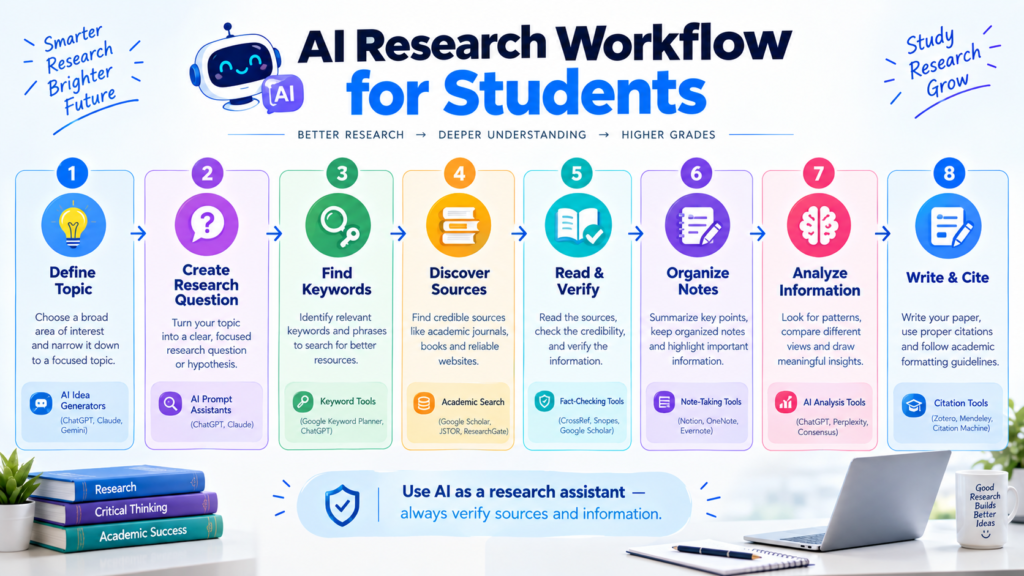
AI Research Workflow for Students
A simple AI-assisted research workflow can look like this:
Define Topic → Create Research Question → Find Keywords → Discover Sources → Read & Verify → Organize Notes → Analyze Information → Create Outline → Write → Cite → Review
The most important part of this process is Read & Verify.
AI can help you move through research tasks faster, but the student should remain responsible for checking the information and making the final decisions.
Useful AI Prompts for Student Research
Here are some practical prompts you can try.
For Topic Ideas
“Give me 10 research topics about [subject] suitable for a college student.”</span>
>For Research Questions
“Create five focused research questions about [topic].”
>For Keywords
“Generate academic search keywords for researching [topic].”
>For Understanding
“Explain this research concept in simple language and provide examples.”
>For Summarizing
“font-size: 16px;”>”Summarize this article and identify its main argument, evidence, findings, and limitations.”
></span>For Organization
“Organize these research notes into logical themes without changing their meaning.”
>For Research Gaps
“Based on these notes, suggest questions or areas that I should investigate further.”
>For Outlining
“Create a research paper outline based on this research question and these notes.”
>For Editing
“Improve the grammar and clarity of this paragraph while keeping my original meaning.”
How to Verify AI-Generated Information
One of the biggest mistakes students can make is assuming that everything an AI tool says is correct.
AI systems can sometimes produce inaccurate information, outdated information, or references that do not exist.
Before using information in an academic project, check:
- The original source
- Author information
- Publication date
- Research methodology
- Statistics
- Citations
- Quotes
- Links and references
- Whether the information actually supports your claim
For important academic claims, go back to the original source instead of relying entirely on an AI summary.
Don’t Ask AI to Invent Sources
Students should never ask AI to create fake references or citations.
For example, avoid prompts such as:
“Create five academic sources that support my argument.”
Instead, ask AI to help you find the type of sources you need, and then locate real sources through your library, academic databases, scholarly search tools, or trusted publications.
After finding a source, verify that it actually exists and supports the statement you want to make.
Use AI Without Losing Your Research Skills
AI can save time, but research skills are still essential.
You should continue learning how to:
- Search effectively
- Read academic papers
- Evaluate evidence
- Identify reliable sources
- Take useful notes
- Compare arguments
- Build logical conclusions
- Cite sources correctly
- Write independently
If AI does every part of the research process for you, you may finish an assignment faster but learn less from it.
The better approach is to use AI to support your learning and improve your research workflow.
Common Mistakes Students Should Avoid
1. Trusting Every AI Answer
AI can make mistakes. Always verify important information.
2. Using AI Summaries Instead of Reading Sources
A summary can leave out important details or context.
3. Copying AI-Generated Writing
Your assignment should reflect your own understanding and follow your institution’s academic rules.
4. Using Fake Citations
Never assume that an AI-generated citation is real.
5. Ignoring Assignment Rules
Some schools and universities have specific policies about AI use. Always follow the rules provided by your instructor or institution.
6. Using AI Without Understanding the Topic
You should be able to explain the ideas in your research yourself.
Benefits of Using AI for Student Research
When used responsibly, AI can provide several practical benefits.
Saves Time
AI can help with brainstorming, organization, summarization, and editing.
Improves Organization
Research notes and ideas can be arranged into clearer categories and outlines.
Supports Understanding
Complex concepts can often be explained in simpler language.
Helps With Brainstorming
AI can provide alternative research questions, keywords, and directions to investigate.
Improves Writing
AI writing assistants can help identify grammar, clarity, and structure problems.
Limitations of AI for Research
AI is not a replacement for academic research.
Some limitations include:
- Incorrect information
- Outdated knowledge
- Misleading summaries
- Missing context
- Incorrect citations
- Overly confident answers
- Lack of understanding of your specific assignment
- Potential academic-integrity issues
Because of these limitations, students should treat AI output as something to check and evaluate, not automatically accept.
Final Thoughts
AI can be a useful research assistant for students. It can help you choose a topic, develop research questions, generate keywords, understand difficult concepts, summarize material, organize notes, compare ideas, and create a research outline.
But effective research still requires human judgment.
The best approach is to use AI for supporting tasks while keeping yourself responsible for reading sources, checking facts, evaluating evidence, developing arguments, and writing the final work.
When you use AI this way, it becomes a productivity and learning tool rather than a replacement for genuine research.
